
 English
 русский
 Español
- SS Series Fully Automatic CNC Pipe Bending Machine
- CNC S Series Fully Automatic Tube Bending Machine with Optional Simulation Function
- CNC M Series Fully Automatic Multi-Radius Tube Bending Machine
- CNC L Series Fully Automatic Tube Bending Machine with Servo-Hydraulic Control
- CNC Series Tube Roll Bending Machine with Three-Roller Drive
- CNC Series Tube Roll Bending Machine for Metal Profiles
CNC Pipe Bending Machine Guide: How They Work, Types and Selection
Date:Oct 23, 2026
Content
Few operations shape a fabrication shop's capability as directly as tube bending. A CNC pipe bending machine brings automation, repeatability, and precision to this step, allowing manufacturers to produce complex bends consistently, part after part. Whether you are forming thin-wall tubing for furniture frames or heavy pipe for structural applications, understanding how these machines work and what they offer helps you make a more confident equipment decision.
What Is a CNC Pipe Bending Machine?
A CNC pipe bending machine is a numerically controlled forming system that bends tube and pipe to programmed angles, radii, and planes. Unlike manual or semi-automatic benders, which depend on operator skill and mechanical stops, CNC models use servo-controlled axes to coordinate feeding, rotation, and bending. That allows multiple bends to be completed in one setup, with the control system remembering every angle, distance, and rotation.
A modern CNC bender typically supports:
- Multiple bend angles and bend radii in a single program.
- Rotation of the tube between bends to form three-dimensional shapes.
- Mandrel-assisted bending to prevent collapse on thin-wall workpieces.
- Automatic feeding, clamping, and unloading for higher throughput.
Because changeovers are handled through software rather than physical tooling adjustments, CNC bending serves both long production runs and short job-shop batches. The same machine can move from a simple single-bend part to a complex multi-bend assembly with minimal downtime.
How CNC Pipe Bending Works
A typical CNC bending cycle coordinates three main motions:
- Feed (Y-axis): The tube advances longitudinally to position each bend point.
- Rotation (C-axis): The tube rotates around its own axis to set the plane of the bend.
- Bend (X-axis): The bend arm pulls the tube around the former die to the programmed angle.
These axes are governed by a CNC controller that accepts programs created at the console or generated offline in 3D simulation software. Simulating a program before running it reduces trial and error, which is especially valuable for expensive materials or tight-tolerance work in aerospace and automotive projects.
Key Tooling in a CNC Bender
Bending quality depends on more than the machine frame. The tooling package does much of the work:
- Bend die (former): defines the bend radius and supports the tube on the inside of the curve.
- Clamp die: holds the tube against the bend die so the bend arm can pull it around.
- Pressure die: supports the straight section of the tube opposite the bend die.
- Wiper die: prevents wrinkling on the inner side of the bend, especially in thin-wall work.
- Mandrel: supports the inside of the tube to keep the cross-section round through the bend.
Choosing the correct tooling material and geometry is part of the setup conversation with a machine supplier, and it directly affects part quality and tool life.
NC vs CNC: What Is the Difference?
Both NC and CNC machines use programmed control, but they differ in automation and flexibility. NC models typically execute a preset sequence with mechanical stops and manual adjustments between jobs, while CNC models use servo-driven axes and full software control.
| Feature | NC Bending Machine | CNC Bending Machine |
|---|---|---|
| Control method | Preset program sequence | Multi-axis servo control |
| Setup and changeover | Manual die and stop adjustment | Software program changeover |
| Typical geometry | Single-plane simple bends | Complex multi-plane 3D parts |
| Repeatability | Good for small batches | High precision for long runs |
| Operator involvement | Higher | Lower after programming |
If you are trying to decide between the two, our guide to NC pipe bending machines covers the practical differences in more detail.
Key Benefits of CNC Pipe Bending
Manufacturers choose CNC bending for several practical reasons:
- Repeatability: Once a program is saved, every part is formed to the same tolerance, even in unattended operation.
- Material savings: Precise positioning reduces scrap, which matters with stainless steel, aluminum, and expensive alloys.
- Labor efficiency: One operator can supervise multiple machines, and automatic cycles free skilled staff for other tasks.
- Complex geometry: Multi-axis control allows shapes that would be difficult or impossible to produce consistently by hand.
- Program storage and traceability: Bending programs can be archived, versioned, and reused for future orders, supporting quality documentation.
These benefits add up quickly in production. A machine that removes guesswork from the bending process also makes quoting more reliable, because cycle times and material usage become predictable.
Types of CNC Pipe Bending Machines
CNC bending machines come in several configurations, each suited to particular part families:
- Single-head CNC benders: the most common type, covering standard tube diameters and offering either a single radius or multi-radius capability.
- Rotary-head benders: allow left-hand and right-hand bending in one setup without repositioning the tube, ideal for complex frames and exhaust lines.
- Double-head CNC benders: form both ends of a tube in one cycle, which is efficient for symmetrical parts such as handles, racks, and furniture components.
- Roller and multi-radius machines: handle variable-radius curves, large profiles, and continuous shaping work.
When a workpiece requires more than one bend radius and tooling changes must be kept to a minimum, the CNC M-Series fully automatic multi-radius bending machine is a practical choice. It stores multiple radii in the program and changes them automatically, reducing setup time and improving consistency.
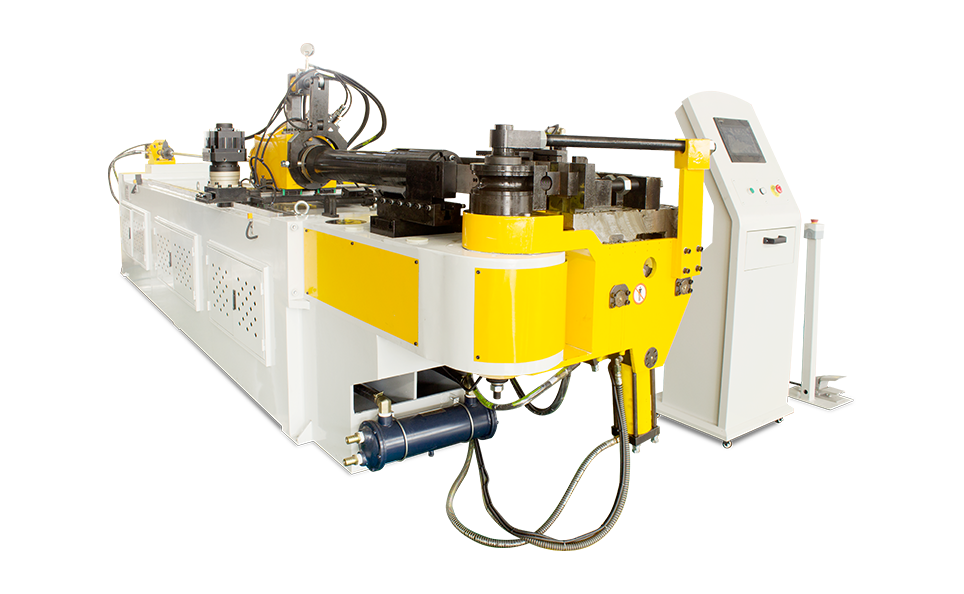 CNC M-Series Fully Automatic Multi-Radius Tube Bending MachineIdeal for parts requiring multiple bend radii without tooling changes, this servo-hydraulic unit stores programs and adjusts automatically, reducing setup time and ensuring consistent results.View Product →
For general-purpose bending of tube and pipe in medium to large batches, the CNC L-Series servo-hydraulic model offers a strong balance of speed, torque, and reliability. It is a common choice for automotive, furniture, and general fabrication work.
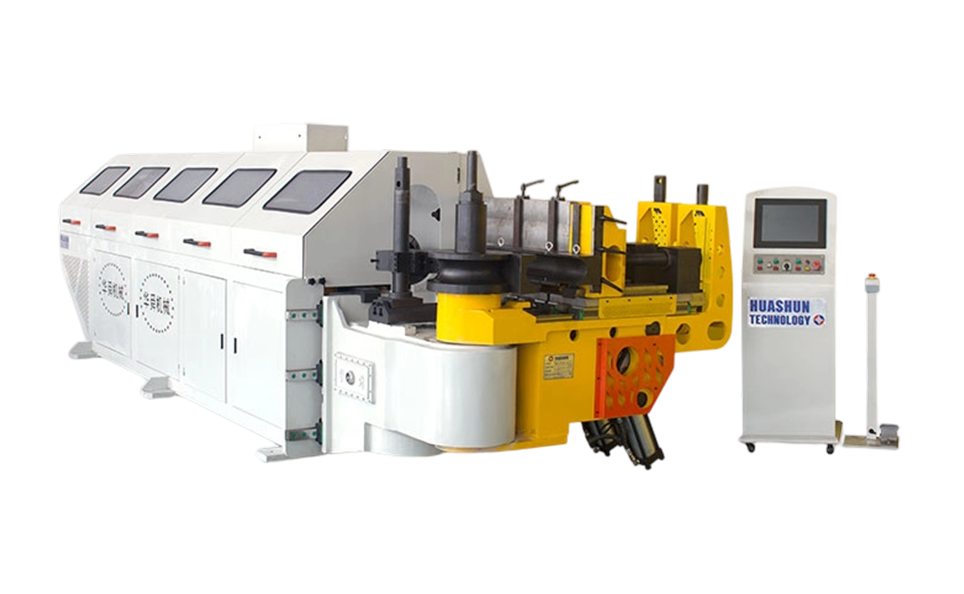 CNC L-Series Servo-Hydraulic Tube Bending Machine for Medium to Large BatchesOffering a balance of speed, torque, and reliability, the L-Series handles automotive and fabrication tasks efficiently with three servo axes and hydraulic or CNC bending modes.View Product →
Shops that only occasionally need full CNC capability sometimes ask whether a simpler machine is enough. The answer depends on part volume and complexity. If parts vary, tolerances are tight, or 3D shapes are involved, CNC control pays for itself quickly.
Industries and Applications
CNC pipe bending machines appear in nearly every sector that manufactures with metal tube. In automotive manufacturing, they form exhaust lines, roll bars, chassis components, and brake or fuel lines — a workflow described in more detail on our automotive manufacturing page.
In aerospace, tight-tolerance bends in thin-wall, high-strength alloys demand mandrel support and dependable axis control. Construction and decoration uses bent pipe for railings, handrails, and architectural structures, while HVAC contractors rely on clean, consistent curves for refrigerant and coolant lines. Fitness equipment manufacturers, home appliance producers, and agricultural machinery builders all use formed tube for structural and functional parts.
Contract manufacturers and job shops gain another advantage: fast program changeovers make it economical to serve different customers with different part shapes and materials. If your shop handles mixed production, the ability to recall a program from storage and start bending within minutes is a real competitive edge.
How to Choose a CNC Pipe Bending Machine
Choosing the right machine starts with a clear inventory of your current and planned workpieces. These factors matter most:
- Tube diameter and wall thickness: Choose a machine rated for the largest size you process regularly, not just for occasional jobs.
- Bend radius: If a single part needs several radii, consider a multi-radius CNC model.
- Mandrel requirements: Thin-wall tube and tight radii usually require mandrel-assisted bending to avoid wrinkling or collapse.
- Part length and feed stroke: Long tubes call for a longer feed axis or an automatic loader.
- Production volume: Higher volumes justify added automation, including auto loading and unloading.
- Offline programming and simulation: 3D simulation shortens setup time and reduces material waste, particularly for prototype work.
A common mistake is to oversize the machine for the largest tube the shop will ever bend, then run it most of the time at a fraction of its capacity. It is usually smarter to match the machine to your typical production range and add a second unit later for larger or smaller work.
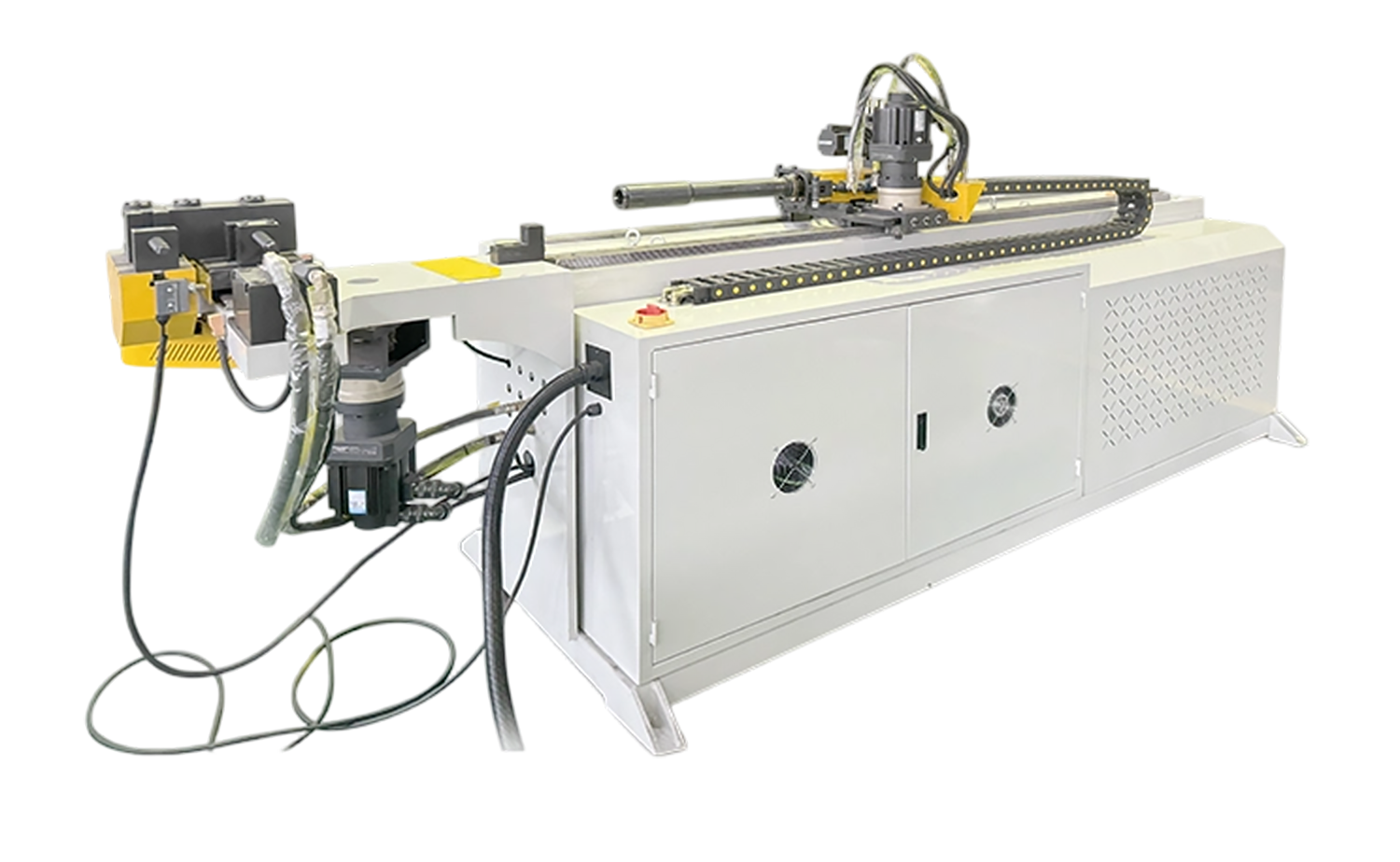
For shops that want full CNC capability in a compact, cost-conscious package, the SS-Series is a widely selected fully automatic option. It combines the essential axes, mandrel control, and programmed operation in a machine that fits comfortably into small and medium fabrication shops.
 SS-Series Compact Fully Automatic CNC Pipe Bending MachineA cost-conscious CNC option with three axes and high accuracy, the SS-Series suits small to medium shops, delivering programmed bending in a space-saving frame.View Product →
Budget matters, but it should not be the only factor. Consider the total cost over five years: scrap rate, setup hours, tooling, maintenance, and the ability to quote more complex work. A slightly more expensive machine can be the more economical choice over its service life.
Investing in the Right Bending Technology
A CNC pipe bending machine is more than a piece of tooling; it is the center of a repeatable, traceable bending process. The right configuration reduces scrap, shortens lead times, and gives your shop the capability to accept more complex work.
At HuaShun, we have spent years building tube bending equipment that balances performance, durability, and everyday usability. We encourage you to review your part mix and production targets before selecting a model — and when you are ready to talk details, our team is glad to help you match the machine to the job.


Copyright © 2025 Huashun Technology All Rights Reserved.
Custom Precision Tube Forming Machine Manufacturers