In Modern Heat Exchanger Manufacturing and Pipe Forming
In modern heat exchanger manufacturing, refrigeration system production, and automotive air conditioning component processing, pipe forming technology is rapidly advancing. Serpentine tubes play an indispensable role in heat exchangers and heat transfer systems due to their multi-segment bends, compact space requirements, and high precision. Traditional manual tube bending methods struggle to meet modern production needs because human operation can easily cause bending radius errors, surface dents, and uneven cut ends.
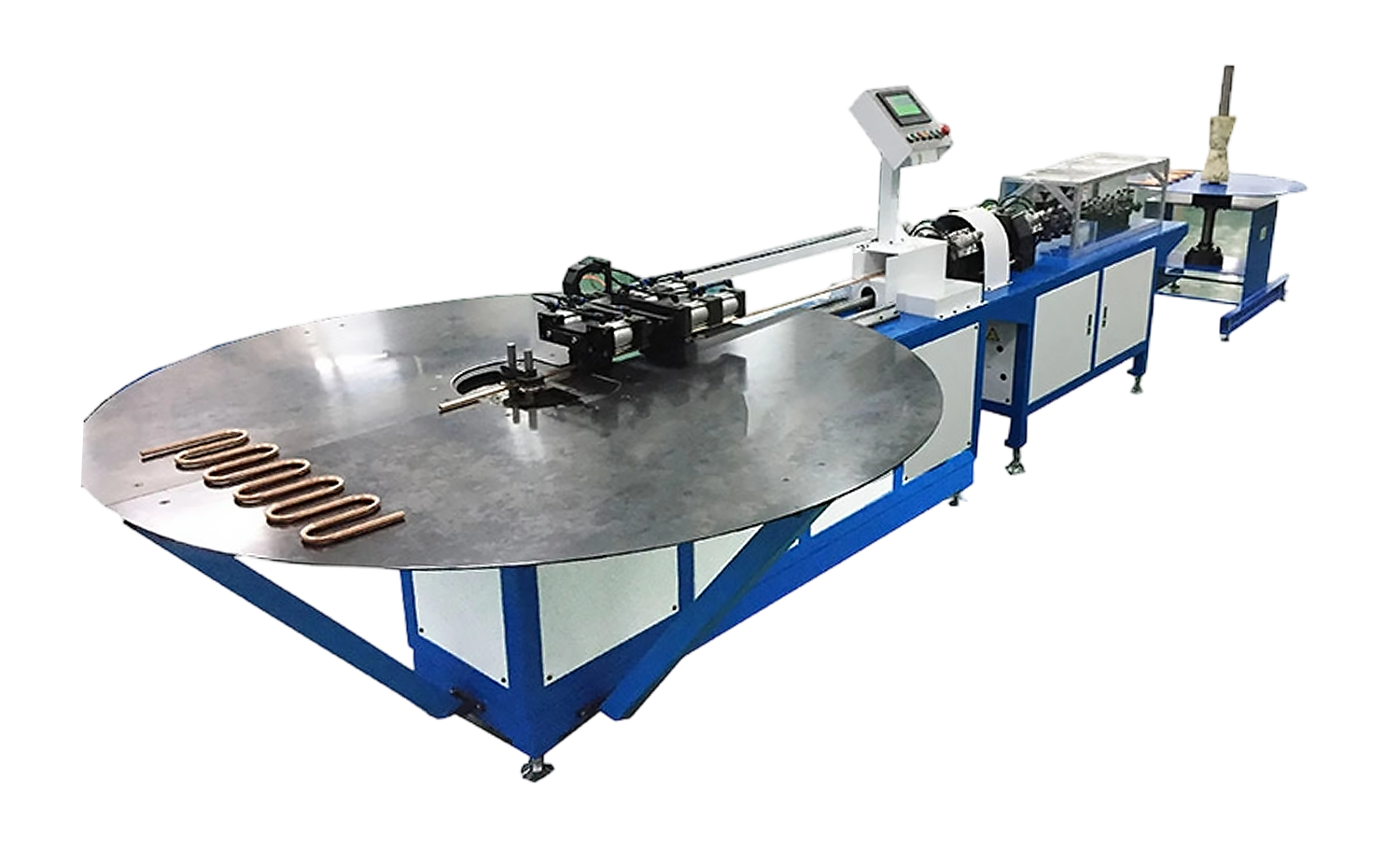
To address these challenges, the SB-20CNC Series Full Automatic Serpentine Bender has become a core solution. This machine integrates decoiling, straightening, cutting, and bending into a single production line, enabling an end-to-end process from raw material to finished product. This high level of integration not only optimizes production cycles but also significantly reduces labor involvement, saving costs and improving production efficiency and product quality.
Technical Structure and Process Advantages of the Fully Automatic Serpentine Bender
The SB-20CNC Series Full Automatic Serpentine Bender reflects systematic design thinking. The machine is composed of an automatic feeding system, straightening device, chipless cutting system, servo-controlled bending system, and a three-part clamping die. Each module is precisely engineered to ensure the stability and high precision of the entire production process.
Material is first fed into the machine by the automatic feeding system, which not only delivers the material but also controls tension, feeding speed, and adapts to the material’s physical properties to synchronize perfectly with downstream processes. The tension control unit monitors pipe tension in real time and automatically adjusts reel speed, preventing stretching in flexible copper tubes or twisting in brittle aluminum tubes. Multiple feed rollers ensure smooth transport, minimizing friction and surface scratches. The PLC or embedded control unit monitors the entire feeding process, achieving closed-loop control for enhanced stability and safety. In high-output refrigeration pipe production, this system can feed over 10 meters of pipe per minute with a tension deviation of less than 5%, significantly improving production stability.
Next, the pipe passes through the straightening device, where multi-stage rollers progressively straighten the material. Roller pressure, spacing, and arrangement are automatically adjusted according to pipe diameter and material, ensuring straightness meets processing requirements. Laser sensors monitor deformation in real time, feeding back data for closed-loop adjustment. For high or low-temperature pipes, rollers are made of heat-resistant alloys to maintain processing stability. In the refrigeration industry, using this straightening device on copper tubes can limit initial bending angles to within 0.5°, ensuring optimal straightness before cutting and bending and improving welding and bending precision.
The cutting stage uses a chipless cutting system with 360° rotation and two-point clamping, ensuring flat, burr-free cuts and minimizing metal waste. The rotating cutter applies even force, and dual clamps hold the pipe firmly. Cut accuracy reaches ±0.1 mm. High-speed steel or carbide cutters, heat-treated for wear resistance, can cut tens of thousands of pipes without replacement. This chipless cutting technology increases efficiency while providing high-quality ends for welding and assembly.
The servo-controlled bending system is the core of the SB-20CNC, enabling high-precision, multi-segment continuous bending. Servo motors with position sensors provide real-time feedback and dynamic adjustment. The system monitors pipe stress during bending and automatically adjusts speed or clamping force if stress exceeds thresholds to prevent deformation or cracking. Paired with 3D simulation software, bending paths and stress distribution can be optimized in advance, reducing trial and error and material waste. In automotive air conditioning production, this system can create complex serpentine paths in a single aluminum tube, ensuring smooth installation and avoiding leaks or assembly issues.
The three-part clamping die provides uniform holding force during bending, preventing dents or collapse. Dies feature replaceable inserts to accommodate various diameters and materials. Bending spring-back is compensated to ensure angle accuracy. Surfaces are nitrided or chrome-plated for durability, reducing maintenance frequency. In refrigeration equipment production, this die system ensures smooth, aesthetically pleasing bends and facilitates subsequent welding and assembly.
Role of Manufacturers and Factories in Equipment Quality
In serpentine tube bending equipment production, a manufacturer’s technical capabilities and the factory’s production standards directly influence machine performance. Zhangjiagang HuaShun Machinery Manufacture Co.,Ltd. is a leading company with extensive experience in automatic tube bending equipment, emphasizing full-process control from design and R&D to manufacturing. Core components such as bending dies, guiding mechanisms, and clamping systems are produced with high-precision machining equipment, and multiple quality inspections ensure stable operation.
The factory not only handles production but also quality control. Assembled machines undergo continuous operation, load, bending precision, and durability tests to ensure performance under high-load production. Suppliers play a bridging role in the supply chain, offering tailored equipment solutions, technical support, and after-sales services, including sample processing and technical demonstrations to verify machine capabilities for clients.
Refrigeration Industry Applications
In the refrigeration industry, serpentine tubes are widely used in evaporators and condensers, primarily made from copper. Processing requires high bending precision, flat ends, and concentricity to ensure system sealing and heat exchange efficiency. The SB-20CNC advantages include:
Automated bending reduces labor and increases production efficiency
High-precision cutting ensures quality ends and lowers scrap rates
Straightening ensures pipe straightness for improved welding precision
Three-part die prevents dents and improves visual quality
For example, a refrigeration system manufacturer using SB-20CNC can process over 2,000 copper tubes per day, maintaining bending errors under 0.2°, significantly increasing production efficiency and product consistency.
Automotive Industry Applications
Automotive air conditioning systems use many aluminum serpentine tubes, requiring high production efficiency and bending precision. SB-20CNC achieves continuous processing with consistent bending paths for each tube:
Automatic feeding and bending reduce human intervention
High-precision bends ensure smooth installation
Straightening and chipless cutting improve welding quality
Rapid bend radius change adapts to different vehicle models
An automotive AC manufacturer implementing this machine increased single-line daily output by 35%, improving bending consistency and assembly efficiency.
HVAC System Applications
In HVAC systems, Bundy tubes are used for refrigerant transport and heat exchangers, requiring multi-segment bends and high concentricity. SB-20CNC advantages:
Multi-segment automatic bending for complex pipe routes
High concentricity ensures smooth installation
Precise straightening and dies reduce human error
Optional 3D simulation software optimizes pipe design in advance
In large HVAC production, the machine can process multiple Bundy tube diameters simultaneously, ensuring accurate layouts and space-saving installation.
Heat Exchanger Manufacturing Applications
Copper-aluminum composite tubes in heat exchangers require high welding quality. SB-20CNC’s precision cutting and concentricity control enhance welding stability:
Flat cuts facilitate welding
High concentricity ensures welding consistency
Automatic bending reduces human error and improves overall heat exchanger performance
Capable of complex serpentine tube processing for flexible heat exchanger designs
In production, the machine can achieve over 1,000 serpentine tubes per day with superior end finish and bending accuracy compared to traditional manual methods.
Technology Trends and Future Directions
With industrial automation and intelligent manufacturing, serpentine tube bending equipment is evolving toward smart production. Future trends include:
Data analysis and remote monitoring for real-time machine management
AI-assisted optimization of bending paths to reduce energy and material waste
Modular design for quick production specification changes
Integration with other production equipment for fully automated lines
Zhangjiagang HuaShun Machinery Manufacture Co.,Ltd. continues to optimize control systems and structural design to meet diverse global market requirements and expand international presence.
Operation and Safety Management
Operation includes:
1. Pipe installation and tension adjustment
2. System parameter input and program selection
3. Production monitoring and handling anomalies
4. Routine maintenance and lubrication
Safety measures include:
Emergency stop buttons and protective guards
Operator training on safe machine use
Regular maintenance and inspection for long-term safety
FAQ
1. What materials are suitable for the Serpentine Tube Bending Machine?
Primarily aluminum, copper, and Bundy tubes.
2. What are the core advantages of the SB-20CNC?
Full automation and high-precision bending.
3. What are the features of the chipless cutting technology?
Rotary cutting with no material waste and flat ends.
4. What is the function of the three-part die?
Reduces pipe deformation and improves bending quality.
5. How does the servo system enhance precision?
Controls bending angles and speed for high consistency.
6. Is the machine suitable for large-scale production?
Yes, it significantly improves efficiency in continuous production.
7. What role does the manufacturer play?
Design, manufacture, and quality control of the equipment.
8. What services do suppliers provide?
Equipment selection advice, technical support, and after-sales service.


 English
 русский
 Español