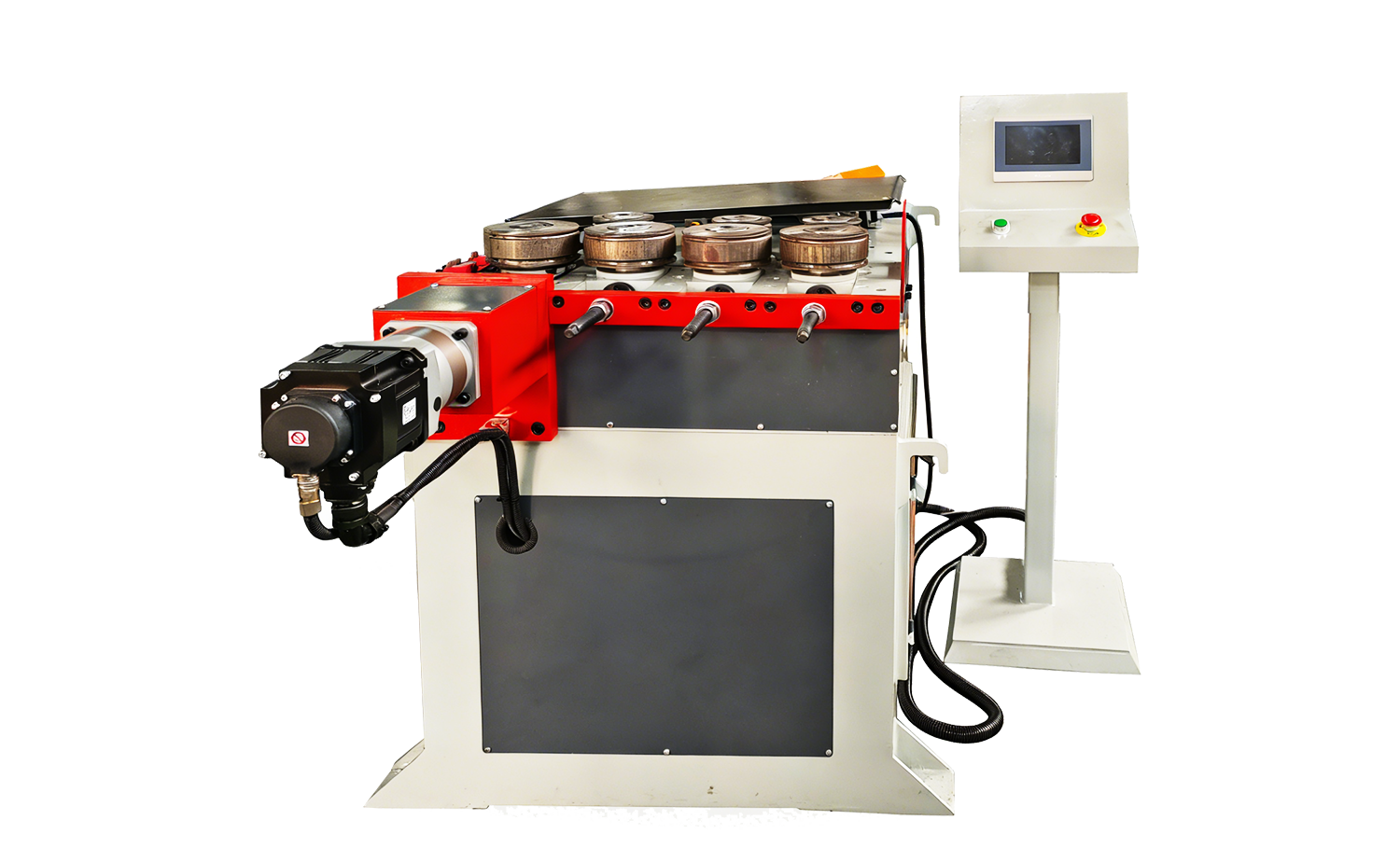
Seven-Roller & Nine-Roller Tube Rolling Machine Technology and Applications
In modern industrial tube processing, seven-roller and nine-roller tube rolling machines (Seven-Roller & Nine-Roller Tube Rolling Machine) have gradually become core equipment for processing thin-walled pipes, large-diameter pipes, and various special cross-section tubes. These machines meet the needs of aerospace, shipbuilding, automotive manufacturing, building structures, and machinery manufacturing industries for high-precision and high-efficiency tube bending. Traditional single-head or double-head pipe bending machines have limitations when processing multiple bending radii and large-diameter pipes. Seven-roller and nine-roller tube rolling machines achieve high-precision and multifunctionality through multiple roller arrangements and servo control.
Taking the GY40 CNC series high-speed thin-walled tube roll bending machine as an example, its core technologies include reducer-driven roller sets, servo motor-controlled diameter changes, foot switch emergency stop design, and replaceable mold grooves. These technologies ensure that thin-walled pipes do not slip during bending and that multiple bending radii can be completed on the same tube. Suppliers provide customized solutions based on pipe diameter, wall thickness, and production rate to ensure factories achieve high-precision results quickly. Manufacturers focus on transmission system balance, roller layout optimization, and CNC control system reliability to maintain consistent processing quality.
Operators can achieve circular, arc, or spiral tube shapes by setting parameters on the touch screen. Replacing mold groove shapes allows processing of angle steel, flat steel, round steel, and other special cross-section profiles, providing high adaptability for factories across multiple industries. Large-radius pipe bending avoids extra-large mold costs, which is a key advantage of seven-roller and nine-roller machines compared to traditional single-head or double-head pipe bending machines. Suppliers provide operational training and technical support to ensure factories quickly master equipment operation and maintain high productivity.
Structure Features and Industrial Adaptability of Seven-Roller & Nine-Roller Tube Rolling Machines
The structure of seven-roller and nine-roller tube rolling machines achieves uniform force distribution through multi-roller arrangements, reducing stress concentration during bending. This design is especially suitable for thin-walled and large-diameter pipes. The wheel drive system is slip-resistant, maintaining high bending accuracy for thin-walled materials and extending roller and mold life. Factories select equipment based on production rate and pipe size. Nine-roller machines, with additional upper, middle, and lower rollers, bend long and large-diameter pipes more smoothly and handle a wider range of materials.
Suppliers often provide complete production line solutions, including feeding, bending, cutting, and finished product inspection, ensuring efficient operation in continuous production. Manufacturers use finite element analysis to simulate bending processes, optimizing roller layout and transmission systems to enhance product consistency and stability. Foot switch emergency stop designs ensure operator safety, and balanced transmission reduces vibration and noise, improving workshop comfort.
The machines exhibit high flexibility in multifunctional applications. Through servo motor and CNC control systems, factories can achieve multiple bending radii on a single tube, meeting the needs of complex building structures, machinery frames, or piping systems. Replaceable molds allow processing of angle steel, flat steel, round steel, and other special profiles, enabling factories to adapt to diversified production needs. Large-radius pipe bending is a key advantage over single-head and double-head machines, saving mold costs and improving production efficiency.
Seven-roller and nine-roller machines are widely applied in aerospace, shipbuilding, high-speed rail, automotive manufacturing, construction steel structures, and machinery industries. In aerospace, tube structural components require high load capacity while maintaining precise bending, ensuring roundness and wall thickness consistency. In shipbuilding, large-radius spiral pipes can be processed without extra-large molds, improving efficiency and reducing costs. In construction steel and machinery manufacturing, angle steel and special-profile pipes improve flexibility and production efficiency. The machines are suitable for high-strength and complex-shape tube processing to meet multi-industry customization requirements.
Suppliers, Manufacturers, and Zhangjiagang HuaShun Machinery Manufacture Co.,Ltd. Advantages
Selecting suitable suppliers and manufacturers is key to ensuring efficient machine operation. Suppliers handle equipment selection, logistics, installation, and technical support, while manufacturers focus on machine structure, transmission systems, control software, and mold development. High-quality suppliers and manufacturers provide customized solutions according to factory production needs and offer long-term technical services to ensure stable and reliable operation.
Zhangjiagang HuaShun Machinery Manufacture Co.,Ltd., as a leading tube processing equipment manufacturer, has 25 years of industry experience, 75 technology patents, 180 professional technical employees, 4 production bases, and exports to 115 countries and regions. The company provides standard seven-roller and nine-roller tube rolling machines and custom machines for thin-walled pipes, large-diameter pipes, and special cross-section profiles. HuaShun Machinery's R&D team continuously optimizes machine structure, transmission systems, and CNC control software to provide stable and reliable production equipment for factories worldwide.
Factories using HuaShun machines can set bending parameters via touch screen to achieve multiple bending radii and replace molds as needed, handling angle steel, flat steel, round steel, and special cross-section profiles. Balanced transmission reduces vibration and noise, and foot switch emergency stops ensure operational safety. Suppliers provide installation, operation training, and maintenance support so factories quickly gain operational expertise, ensuring efficient production.
In aerospace, seven-roller and nine-roller machines ensure thin-walled pipe precision and wall thickness consistency, enhancing structural component reliability. In shipbuilding, large-radius spiral pipes are processed without extra molds, reducing cost. In construction and machinery manufacturing, angle steel and special-profile pipes improve structural flexibility and production efficiency. Machines are suitable for high-strength, complex-shape tube processing across multiple industries.
HuaShun Machinery provides global service networks for suppliers, factories, and manufacturers, ensuring efficient operation in different markets and production environments. The technical team continues to develop new control systems, optimize roller layout, and improve mold designs to meet growing demands for precision and efficiency in industrial tube processing.
FAQ
Q1: What is the main difference between seven-roller and nine-roller tube rolling machines?
A1: Nine-roller machines have additional upper, middle, and lower rollers, allowing smooth bending of large-diameter and long pipes, and adapting to more materials and profiles.
Q2: What types of tubes can be processed?
A2: Thin-walled pipes, thick-walled pipes, large-diameter pipes, angle steel, flat steel, round steel, and special cross-section profiles.
Q3: How is multiple bending radii achieved?
A3: By controlling tube diameter with a servo motor and setting different bending radius parameters on the touch screen.
Q4: What safety designs are included?
A4: Equipped with foot switch and emergency stop button, balanced transmission reduces vibration and misoperation risks.
Q5: What are HuaShun Machinery's advantages?
A5: 25 years of industry experience, 75 technology patents, 180 technical employees, 4 production bases, 115 export countries, providing standard and customized machines with global technical services.
Q6: Are the molds replaceable?
A6: Yes, different mold grooves can be replaced to accommodate different cross-section profiles.
Q7: How should factories maintain the machines to extend service life?
A7: Regularly inspect rollers, transmission systems, and mold wear, perform lubrication and maintenance according to supplier manuals to ensure long-term stable operation.


 English
 русский
 Español