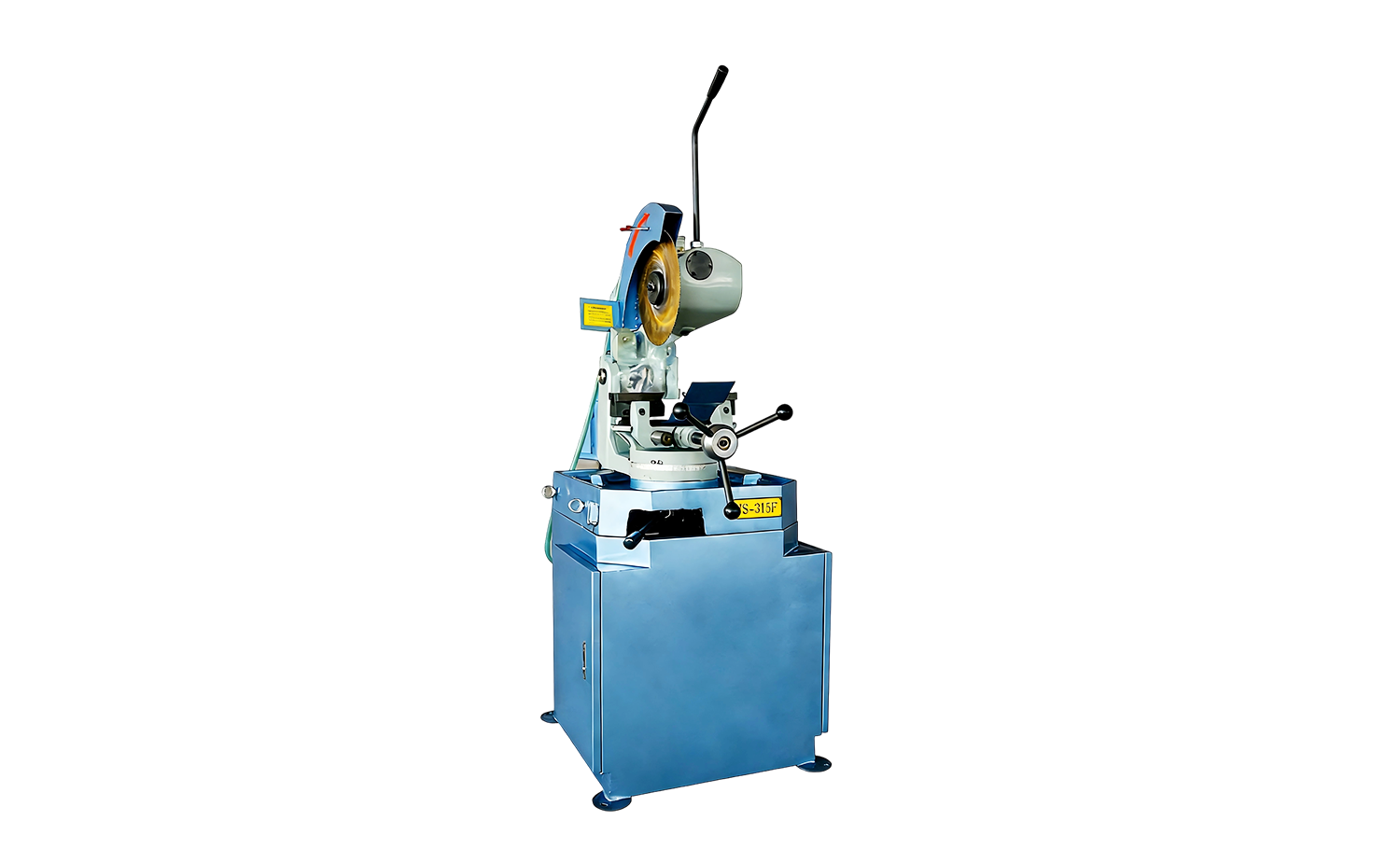
Semi-Automatic Manual Tube Cutting Machine Industry Technology Analysis and Application Expansion – Case Study of F Series Manual Pipe Cutting Machine
In the context of ongoing upgrades in the manufacturing industry, tube processing equipment is moving toward high precision, multifunctionality, and flexibility. Semi-Automatic Manual Tube Cutting Machine, as an important link between traditional manual operations and fully automated equipment, plays an irreplaceable role in numerous industrial scenarios. Especially with the growing demand for multi-variety, small-batch, and customized production, this type of equipment has gradually become a key component in many factory production systems due to its strong flexibility, intuitive operation, and low maintenance cost.
F Series Manual Pipe Cutting Machine serves as a typical example, with structural design, processing capabilities, and stable performance offering high reference value in the industry. Focusing on this equipment allows a deeper understanding of the development logic, technical details, and practical application models of semi-automatic manual tube cutting machines. Meanwhile, with suppliers and manufacturers continuously promoting technological innovation, this type of equipment has gradually formed a complete industrial chain system and is widely used in factories worldwide.
1. In-Depth Analysis of Equipment Structure System and Processing Principles
The core advantage of Semi-Automatic Manual Tube Cutting Machine comes from its rational structure design and flexible operation. The F Series Manual Pipe Cutting Machine adopts a high-rigidity frame as the foundation, optimizing the mechanical transmission path to maintain stability during operation. Such stability is crucial for metal cutting, as even minor vibrations can directly affect the flatness and precision of the cut surface.
The working process of the equipment is mainly manually controlled, including feeding, positioning, clamping, and cutting. Operators can adjust cutting parameters according to different tube sizes, materials, and processing requirements. This high degree of control provides a clear advantage when handling complex cutting needs. For example, in non-standard tube size processing or small-batch customized orders, operators can quickly adjust cutting strategies without complex program modifications.
In the cutting system, the F Series Manual Pipe Cutting Machine uses high-performance saw blades as the core tool, driven by a stable drive system to achieve high-speed rotation. The contact process between the saw blade and the tube is precisely designed to ensure uniform cutting force distribution, reducing localized stress concentrations. This not only improves cutting quality but also significantly slows down tool wear.
The clamping system is also an essential component. High-strength clamps keep the tube stable during cutting, preventing slippage or misalignment that may cause cutting errors. This stable clamping capability is particularly crucial in industries with high precision requirements, such as automotive parts manufacturing and precision machinery.
Additionally, the equipment supports angled cuts. By adjusting the cutting head or workpiece positioning device, operators can achieve different cutting angles. This function is particularly significant in structural manufacturing, for example, at frame joints, where angled cuts improve both assembly strength and aesthetic quality.
2. Multi-Material Adaptability and Process Quality Control System
The F Series Manual Pipe Cutting Machine demonstrates high adaptability to various materials, including carbon steel, stainless steel, and multiple metal alloys. This wide applicability allows the equipment to meet processing needs across diverse industrial sectors.
During carbon steel cutting, the machine optimizes cutting speed and feed rate to achieve efficient and stable processing. Carbon steel has high strength, generating significant cutting force, so the equipment requires sufficient rigidity and power support. The F Series Manual Pipe Cutting Machine addresses this challenge through reinforced structural design.
When processing stainless steel, due to its toughness and corrosion resistance, heat can easily accumulate during cutting. To address this, the machine is equipped with a water-cooling and lubrication system. This system continuously cools the saw blade and workpiece during cutting, effectively reducing temperature and preventing material deformation. At the same time, lubrication reduces friction, ensuring smoother cutting and higher quality results.
The equipment provides high flexibility in cutting shapes, including round tubes, square tubes, rectangular tubes, and solid bars. In practical production, this multi-shape capability significantly improves equipment utilization. For example, during a production cycle, the machine can continuously process different sizes and shapes without frequent equipment changes.
Cutting quality control covers not only surface smoothness but also edge perpendicularity and dimensional accuracy. The F Series Manual Pipe Cutting Machine uses precision-guided structures and stable transmission systems to achieve high-precision cuts. The cut tube surfaces are smooth, burr-free, which is crucial for subsequent welding and assembly operations.
Key performance indicators are shown in the table below:
| Performance Indicator |
Conventional Manual Tube Cutting Equipment |
F Series Manual Pipe Cutting Machine |
| Cutting Precision |
Average |
High and stable output |
| Cut Surface Quality |
With burrs |
Smooth and burr-free |
| Noise Level |
High |
Low-noise design |
| Material Compatibility |
Limited |
Multi-material compatible |
| Operational Flexibility |
Medium |
Highly flexible |
| Equipment Lifespan |
Ordinary |
Long-term stable operation |
Regarding noise control, the equipment achieves low-noise operation by optimizing mechanical structures and transmission methods. This feature is particularly important in modern factories, improving working conditions for operators while complying with industrial noise regulations in some countries.
Durability is another significant aspect. High-strength materials and precision manufacturing ensure that critical components have a long service life. During long-term operation, the equipment maintains stable performance and reduces the frequency of failures, thereby lowering maintenance costs.
3. Manufacturing System, Global Supply Chain, and Factory Application Scenarios
In the development of Semi-Automatic Manual Tube Cutting Machines, the technical accumulation of suppliers and manufacturers plays a decisive role. Zhangjiagang HuaShun Machinery Manufacture Co.,Ltd. has been deeply engaged in this field for years, forming a complete system for equipment R&D and manufacturing through continuous innovation and production optimization.
With 25 years of industry experience, the company has built a solid technical foundation in tube processing equipment. The accumulation of 75 technology patents covers equipment structural design, cutting process optimization, and control systems, continuously improving product performance and reliability. The company employs 180 professionals across R&D, production, quality control, and after-sales service, creating an efficient and collaborative operational model.
In terms of production capacity, the company operates four manufacturing bases, capable of meeting orders of different scales. From raw material procurement to final assembly, every stage undergoes strict quality control to ensure equipment performance stability. Products have been exported to 115 countries, establishing a wide application base globally.
In practical factory applications, F Series Manual Pipe Cutting Machines typically serve as critical front-end equipment in production lines. Their primary function is to process raw tube materials into semi-finished products that meet dimensional requirements, providing a solid foundation for subsequent operations. In furniture manufacturing, the machines are used for cutting metal frames, ensuring component consistency. In automotive production, they process exhaust systems and structural parts to improve assembly accuracy.
In the construction and fire protection pipe industries, the equipment quickly handles various tube specifications, supporting grooving and connection processes. In these scenarios, equipment stability and cutting quality directly affect overall production efficiency and product quality.
Typical production processes include: raw material storage, initial tube cutting, deburring and surface treatment, welding and assembly, followed by final inspection and packaging. Within this workflow, cutting equipment performance significantly impacts the production pace.
As global manufacturing continues toward more refined and precise processes, Semi-Automatic Manual Tube Cutting Machines will maintain stable demand. Their flexibility and cost advantages make them an important complement to automated equipment. With continuous innovation by suppliers and manufacturers, these machines will keep optimizing structural design and cutting performance to adapt to increasingly complex industrial applications.


 English
 русский
 Español