
 English
 русский
 Español
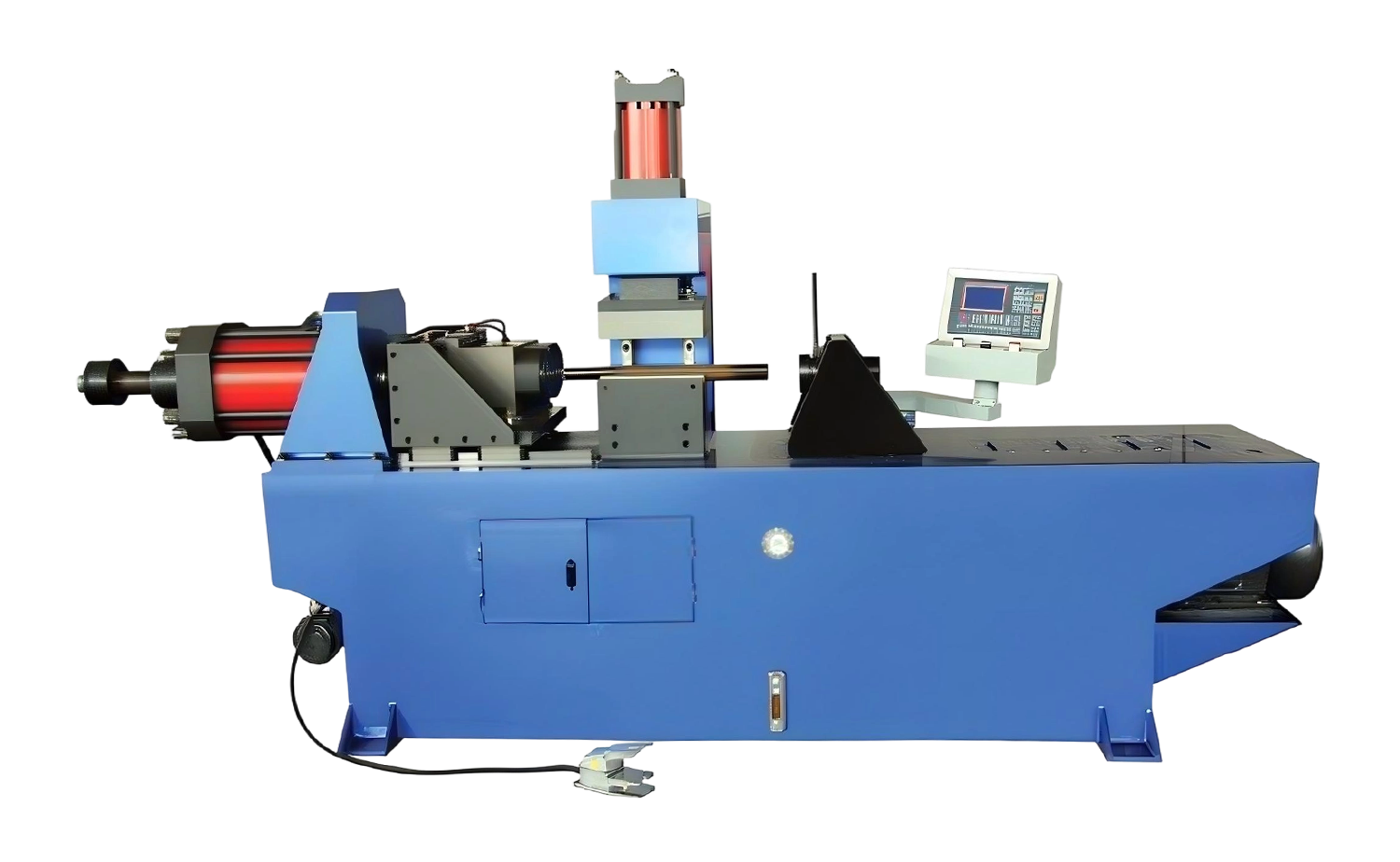
Smart tube end forming represents the convergence of precision metalforming, real-time process intelligence, and adaptive machine control. As manufacturers across automotive, aerospace, HVAC, hydraulics, and medical device sectors demand higher dimensional consistency, faster changeovers, and traceable production data, the traditional approach of fixed-die end forming -- adjusted manually and verified only at offline inspection -- is giving way to sensor-integrated, software-driven systems that monitor, adapt, and document every forming cycle automatically.
What Is Tube End Forming and Why Intelligence Changes Everything
Tube end forming is the process of reshaping the open end of a tube to create a geometry -- such as a flare, bevel, expansion, reduction, beading, or profile -- that allows the tube to connect, seal, or integrate with another component. It is a foundational operation in fluid system manufacturing, where tube ends must mate precisely with fittings, manifolds, and assemblies under pressure. The quality of the formed end determines whether the joint seals reliably, withstands vibration and thermal cycling, and meets the leak-test criteria specified by the end application.
Conventional tube end forming machines operate on open-loop principles: the operator selects a tool, sets a stroke depth, and relies on the rigidity of the tooling and the consistency of incoming tube material to produce acceptable parts. When tube wall thickness varies batch to batch, when material hardness drifts within an alloy specification, or when tooling wears progressively, the formed geometry drifts with it -- often undetected until a downstream inspection step catches nonconforming parts. Smart tube end forming addresses this fundamental limitation by introducing closed-loop measurement and control into the forming cycle itself.
Core Technologies That Define Smart End Forming
In-Process Force and Displacement Sensing
The most foundational technology in smart tube end forming is the integration of force transducers and precision displacement sensors directly into the forming head or press ram. During each forming stroke, the machine generates a real-time force-displacement curve -- a signature that encodes information about material resistance, tooling engagement, and forming progression. Smart systems compare each live force-displacement curve against a learned reference envelope. Deviations from this envelope that exceed defined tolerance bands trigger automatic alerts, rejected-part flags, or adaptive control responses before the cycle completes.
Force monitoring is particularly powerful because it detects the effects of material variation invisibly -- a tube blank that is harder than nominal will produce a higher-than-expected force curve even if the formed geometry appears correct to visual inspection. Conversely, a softer-than-nominal blank may form to the correct geometry but with insufficient work hardening, leaving the joint weaker than intended. Force signature analysis captures both scenarios in ways that dimensional measurement alone cannot.
Servo-Electric Actuation and Position Control
Traditional tube end forming machines are hydraulic or mechanical-cam driven, producing forming force through fixed-stroke mechanisms that are difficult to adjust and impossible to reprogram mid-cycle. Smart tube end forming systems are predominantly servo-electric: the forming axis is driven by a precision servo motor through a ball screw or direct-drive mechanism, giving the control system the ability to position the forming tool at any point in its travel range with sub-millimeter accuracy and to vary the forming force profile dynamically during the stroke.
Servo-electric actuation enables features that are architecturally impossible in hydraulic systems: programmable multi-stage forming profiles that apply different forces at different positions during a single stroke; automatic spring-back compensation that advances the tool beyond the nominal endpoint to account for material elastic recovery; and gentle approach velocities that protect tooling from impact loading at the start of contact, extending die service life significantly.
Vision and Dimensional Verification Systems
Integrated machine vision provides post-forming dimensional verification without removing the part from the machine. Camera systems positioned around the forming zone capture images of the completed tube end and compare measured dimensions -- outer diameter at the flare, flare angle, bead geometry, end squareness -- against nominal values and tolerance bands using image processing algorithms. Parts that fall outside specification are flagged and segregated before reaching the next production stage.
More advanced implementations use laser triangulation or structured light scanning to generate three-dimensional profiles of the formed tube end, enabling measurement of asymmetry, ovality, and surface condition in addition to basic dimensional parameters. These measurement outputs feed directly into the machine's statistical process control (SPC) database, building the empirical dataset needed for both real-time control decisions and long-term process capability analysis.
Digital Recipe Management and Rapid Changeover
Smart tube end forming machines store forming parameters as digital recipes linked to part numbers in a central database. When a production changeover is required, the operator selects the new part recipe from the human-machine interface and the machine automatically loads all associated parameters: servo position setpoints, force limits, forming speed profiles, tooling configuration verification requirements, and inspection criteria. Physical tooling changes that remain necessary are guided by step-by-step instructions on the HMI, with sensor confirmation that tools have been correctly seated before the machine releases for production.
This recipe-driven architecture delivers changeover times measured in minutes rather than the hours that manual setup of conventional machines requires. It also eliminates setup-error-induced scrap at the start of each production run -- a significant contributor to waste in high-mix tube fabrication environments.
End Forming Processes Enhanced by Smart Technology
Flaring
Flaring expands the tube end outward at a defined angle -- typically 37 or 45 degrees for hydraulic and pneumatic fittings -- to create a conical sealing surface that mates with a matching fitting cone. Smart flaring machines monitor the forming force profile to detect when the tube wall has been correctly displaced to the target angle and applies a controlled dwell force to ensure full seating of the flare geometry without cracking the tube wall at the flare root. Material-adaptive force control is particularly valuable for flaring stainless steel and high-strength aluminum alloys where the working force window between underfill and cracking is narrow.
Beading and Grooving
Beading forms a raised circumferential ring on the tube outside diameter that retains a hose or sleeve against pullout forces. Grooving cuts or forms a recessed circumferential channel for O-ring seating or circlip retention. Both operations require precise control of forming depth relative to the tube wall thickness, which varies within material specification. Smart beading machines use real-time diameter sensing to measure the actual tube outside diameter before forming and automatically adjust the forming tool's radial penetration to achieve a consistent bead height relative to the measured starting diameter, rather than to a fixed nominal.
Expanding and Reducing
End expansion and reduction modify the tube inside or outside diameter over a defined length to create transition geometry for slip-fit joints, press-fit assemblies, or flow transition sections. Smart systems control the expansion or reduction force profile to keep the deformation within the material's forming limit, preventing necking during reduction and splitting during expansion. Multi-pass forming sequences -- each pass incrementally deforming the tube end toward the final geometry -- are programmed as digital profiles and executed with servo precision, enabling larger total deformations than single-pass conventional tooling can achieve without annealing.
End Cutting and Facing
Orbital cutting and facing operations that produce a square, burr-free tube end prior to end forming are increasingly integrated into smart forming cells as the first station in a multi-operation sequence. In-machine length measurement after cutting confirms that the tube blank is within length tolerance before the forming sequence begins, preventing the downstream defect of an end form that is correctly shaped but incorrectly positioned relative to the tube's overall length.
| End Form Type | Primary Application | Smart Control Focus | Key Material Challenge |
|---|---|---|---|
| Single / Double Flare | Hydraulic and brake lines | Force-angle profile, spring-back compensation | Cracking in high-strength alloys |
| Bead / Raised Ring | Hose retention, HVAC | Diameter-adaptive depth control | Wall thinning at bead root |
| Expansion | Slip joints, heat exchangers | Multi-pass force profiling | Splitting in thin-wall tube |
| Reduction / Swage | Fittings, flow transitions | Incremental deformation sequencing | Buckling in soft alloys |
| Profile / Contour | Aerospace structural, medical | 3D vision verification | Symmetry and ovality control |
| Facing / Squaring | Weld prep, precision assembly | In-machine length verification | Burr and perpendicularity |
Smart End Forming in the Context of Industry 4.0
Smart tube end forming machines do not operate in isolation. Their value is multiplied when integrated into a broader digital manufacturing environment where production data from individual machines flows to plant-level manufacturing execution systems (MES), quality management platforms, and enterprise resource planning (ERP) systems.
Data Connectivity and OPC-UA
Modern smart forming machines communicate via OPC Unified Architecture (OPC-UA), the industrial internet of things communication standard that enables secure, structured data exchange between machines of different manufacturers and vintages. Through OPC-UA, each forming machine continuously publishes its operating state, cycle count, force curve data, alarm history, and quality outcomes to the plant network. This data stream feeds real-time dashboards that give production managers visibility across all forming cells simultaneously -- identifying which machines are running, which are in alarm, and which are approaching the tool life limits that predict increasing dimensional variation.
Statistical Process Control and SPC Integration
The continuous dimensional and force data generated by smart forming systems feeds directly into SPC software that tracks process capability indices (Cp, Cpk) for each critical characteristic on each part number in real time. When a process capability index drops below the specified minimum, the SPC system generates an alert that prompts the operator to investigate -- adjusting tool position, replacing a worn die, or calling a process engineer -- before the process drifts out of specification and produces nonconforming parts. This proactive response to capability drift, enabled by continuous data collection, is fundamentally different from the reactive response to discovered defects that characterizes conventional forming operations.
Traceability and Digital Part Records
In regulated industries such as automotive safety systems and medical devices, traceability -- the ability to reconstruct the complete manufacturing history of a specific part -- is a compliance requirement. Smart tube end forming systems create a digital record for every part produced: the forming date and time, machine identity, tooling identity and cycle count, force-displacement curve, dimensional measurement results, and operator identity. These records are stored and retrievable by part serial number or by production batch, enabling complete root-cause analysis of any field event and providing objective evidence of conformance at the time of manufacture.
Predictive Tooling Maintenance: The Hidden Cost Reducer
Tooling wear is the primary cause of gradual dimensional drift in tube end forming operations. Smart systems track the force signature of each forming cycle and apply algorithms that detect the subtle shifts in force profile associated with progressive die wear -- increased forming force, shifted peak force position, asymmetric load distribution -- before those shifts produce out-of-tolerance parts. Maintenance alerts triggered by force signature analysis allow tooling replacement to be scheduled at planned intervals rather than discovered after a scrap event. In high-volume operations, predictive tooling maintenance enabled by smart process monitoring typically reduces total tooling cost per part by 20 to 35 percent compared to interval-based or failure-triggered replacement strategies.
Materials and the Adaptive Forming Advantage
The proliferation of advanced materials in tube fabrication has made adaptive forming control more valuable than ever. Automotive brake and fuel line tubing has largely transitioned from mild steel to double-wall steel, stainless steel, and aluminum alloys with higher strength and narrower forming windows. Aerospace hydraulic tubing in titanium alloys and Inconel requires forming forces and deformation limits that conventional fixed-stroke machines cannot safely apply without risk of tube cracking or tooling fracture. Medical device tubing in nitinol, cobalt-chromium alloys, and ultra-thin stainless steel demands forming precision that only sensor-driven adaptive control can reliably maintain.
Aluminum Alloy Tube End Forming
Aluminum alloys present a combination of challenges for end forming: relatively low elongation in heat-treated tempers, strong spring-back due to high elastic-to-yield stress ratio, and sensitivity to forming speed that can cause adiabatic heating and localized cracking at high ram velocities. Smart forming systems address aluminum-specific challenges through programmable forming speed reduction during the critical deformation phase, automatic spring-back compensation offsets calculated from historical forming data for each alloy and temper, and force-limit monitoring that halts the stroke if resistance exceeds the envelope associated with risk of tube wall failure.
Stainless Steel Tube End Forming
Austenitic stainless steels work-harden rapidly during forming, meaning the resistance to deformation increases significantly as the tube end is progressively shaped. Smart servo-electric forming systems manage this work-hardening effect by modulating forming force throughout the stroke -- applying higher force as the material hardens without exceeding the force limit at which the tube wall cracks at stress concentration points such as the flare root or bead groove. The force-adaptive response of a smart system is inherently more precise than the fixed-stroke approach of a hydraulic machine, which applies whatever force the material resistance requires without independent control of the force magnitude.
Titanium and Exotic Alloy Forming
Titanium alloys in aerospace applications are among the most demanding materials for tube end forming. Their high strength-to-weight ratio, low ductility at room temperature, and strong spring-back require either heated forming -- where the tube end is locally heated to a temperature that restores ductility -- or very precisely controlled cold forming at slow speeds with carefully profiled force application. Smart systems equipped with integrated induction heating at the forming zone can execute temperature-controlled hot forming cycles in which the heating power, forming speed, and force profile are coordinated by the machine controller as a unified process sequence, maintaining the tube end at the optimal forming temperature throughout the deformation phase.
Implementing Smart Tube End Forming: A Practical Roadmap
Transitioning from conventional to smart tube end forming is not simply a machine replacement decision. It involves process characterization, data infrastructure, operator training, and integration with quality management systems. Organizations that approach this transition systematically extract the maximum value from their investment.
- Characterize current process capability: Before specifying new equipment, conduct a measurement system analysis and process capability study on existing forming operations. Quantify current Cpk values for critical characteristics, identify the dominant sources of variation (material, tooling, operator), and establish the baseline scrap and rework rates that smart technology is expected to improve.
- Define critical monitoring parameters: Work with engineering, quality, and production teams to identify which forming characteristics require in-process monitoring versus offline inspection. Not every parameter needs real-time control; focus smart monitoring investment on the characteristics that drive the most quality failures or customer complaints.
- Specify data architecture and integration requirements: Determine how forming machine data will flow to plant-level systems, how part records will be stored and retrieved, and what report formats are required for customer quality documentation or regulatory compliance. Align these requirements with the machine builder's data output capabilities before purchase.
- Plan tooling and fixturing for smart operation: Smart forming machines require tooling that is compatible with the machine's sensor systems and servo actuation architecture. Review existing tooling designs for compatibility with the new machine, and identify which tools require redesign to enable in-process measurement access or are not suited to servo-electric actuation profiles.
- Develop recipe library systematically: Creating the digital forming recipe for each part number requires characterizing the optimal forming parameters for that part's material, geometry, and quality requirements. Plan for a structured recipe development process -- typically involving initial trials, force curve analysis, dimensional verification, and process capability confirmation -- for each part number before releasing it to production.
- Train operators and process engineers on data interpretation: Smart forming machines provide far more process information than conventional machines. The value of that information depends on the organization's ability to interpret it correctly and act on it appropriately. Invest in training that covers force curve analysis, SPC chart interpretation, alarm response protocols, and recipe management procedures.
Quality Outcomes and Return on Investment
The business case for smart tube end forming rests on measurable quality and productivity improvements that accumulate over the service life of the equipment. The most commonly cited outcomes from documented implementations include scrap rate reductions of 30 to 60 percent for high-mix tube fabrication operations, elimination of end-of-line sorting operations previously required to catch dimensional nonconformances, reduction of customer warranty claims related to tube end joint failures, and significant reductions in the cost of quality documentation for regulated industry customers.
Productivity gains come from faster changeover, reduced setup scrap at the start of each production run, and higher machine uptime resulting from predictive tooling maintenance. For operations running multiple shifts on a wide variety of part numbers, the changeover time reduction alone can recover the capital cost premium of smart over conventional equipment within two to three years of operation.
A structured pilot implementation -- deploying smart end forming on one high-volume, quality-critical part family before organization-wide rollout -- provides the empirical data needed to build an accurate return-on-investment case for broader investment, while allowing the organization to develop the internal competencies needed to manage smart forming operations effectively before scaling.
Selecting a Smart Tube End Forming Machine: Key Evaluation Criteria
The market for tube end forming equipment includes both established metalforming machine builders who have retrofitted intelligence onto conventional platforms and purpose-built servo-electric forming systems designed from the ground up for smart operation. The distinction matters because the depth and integration of the sensing, control, and data management capabilities vary significantly between these two approaches.
Control System Architecture
The machine's control system should provide programmable multi-axis servo control with synchronized motion profiles, real-time force monitoring with configurable acceptance windows, integrated SPC data collection with configurable sampling plans, and a recipe management system with password-protected access control. Evaluate whether the control system allows the user to configure force envelope parameters independently for different part recipes, or whether monitoring thresholds are globally fixed -- a critical distinction for high-mix operations.
Sensor Integration and Measurement Resolution
Confirm the resolution and calibration traceability of the machine's force and displacement sensors. Force transducers should have resolution sufficient to detect the force variations associated with material batch-to-batch hardness differences -- typically 0.5 percent of full-scale or better. Displacement sensors should resolve to at least 0.01 mm to support the sub-millimeter dimensional control that smart forming is expected to deliver. Ask machine builders for documented sensor calibration procedures and intervals.
Software Openness and Customization
Evaluate whether the machine's software allows user-defined force envelope shapes, custom SPC characteristic definitions, and configurable data export formats. Closed software architectures that restrict parameter access to the machine builder's service engineers create dependency that limits the user's ability to optimize processes independently. Open architectures that expose forming parameters to qualified user personnel, within defined safety limits, provide long-term operational flexibility that is particularly valuable as part family requirements evolve.
Future Directions: AI-Augmented Tube End Forming
The next generation of smart tube end forming systems is beginning to incorporate machine learning models trained on large datasets of forming cycles, material certifications, tooling histories, and quality outcomes. These models enable capabilities that rule-based control systems cannot replicate: automatic identification of forming anomalies that do not match any predefined pattern; recipe parameter suggestions for new part numbers based on similarity to previously characterized parts; and failure mode prediction that anticipates specific types of tooling wear or material excursions before they manifest in force curve deviations.
Computer vision systems at the forming station are being enhanced with deep learning-based defect classifiers that identify surface cracks, folds, and asymmetry in formed tube ends with accuracy exceeding human visual inspection, at production speeds without any cycle time penalty. These AI-augmented inspection systems are particularly valuable for titanium and stainless steel applications where surface defects in the formed zone can be subtle but structurally significant.
Digital twin technology -- software models that replicate the forming process dynamics in real time using live machine data -- is enabling remote process monitoring and optimization by process engineering specialists who are not physically present at the production facility. A tube fabrication operation with forming cells distributed across multiple plants can be monitored and optimized from a central engineering team, with the digital twin providing the contextual process data needed for informed remote intervention.
Smart Tube End Forming Across Key Industries
Automotive and Electric Vehicle Manufacturing
Automotive tube end forming encompasses brake line flares to SAE and ISO standards, fuel line beads and retention rings, power steering and transmission cooling tube connections, and -- in electric vehicles -- battery thermal management tube fittings. The combination of zero-defect quality requirements, high production volumes, frequent model changeovers, and traceability expectations from OEM customers makes automotive tube fabrication one of the most demanding environments for smart end forming technology. EV platform development has added a new requirement: forming of aluminum alloy cooling tubes with complex multi-geometry ends that are difficult to produce consistently on conventional equipment.
Aerospace Fluid Systems
Aerospace hydraulic and fuel system tubes are formed to exacting dimensional standards -- AS4395, NAS1760, and MIL-F-18280 among others -- with process traceability requirements that mandate a complete manufacturing record for every tube in a flight-critical system. Smart forming systems with integrated digital part records satisfy these traceability requirements automatically as a byproduct of normal production, rather than requiring separate manual documentation steps. The ability to demonstrate process capability through stored force curve and dimensional data provides objective evidence of conformance that supports both first-article approval and ongoing production monitoring.
Medical Device Tube Fabrication
Medical device tubes -- catheters, endoscopic instrument channels, surgical instrument shafts, and minimally invasive device components -- are formed from materials including nitinol, cobalt-chromium, titanium, and thin-wall stainless steel in outer diameters ranging from under one millimeter to approximately 25 millimeters. The extremely tight tolerances, biocompatibility requirements, and regulatory traceability mandates of this sector make smart end forming essential rather than optional. Cleanroom-compatible machine designs with stainless steel surfaces, sealed bearing systems, and low-particulate lubrication are available from specialist builders for medical tube fabrication environments.
HVAC and Refrigeration
Copper and aluminum tubing in HVAC and refrigeration systems requires flares, beads, and expanded ends produced at high volumes with the dimensional consistency needed for reliable refrigerant seal integrity. Leakage in refrigerant systems carries both environmental cost -- from the release of fluorinated greenhouse gases -- and warranty cost that make end-form quality economically significant. Smart forming systems in HVAC tube fabrication deliver the consistency needed to reduce leak-test failure rates and the traceability to support warranty claim analysis.
Conclusion: Intelligence as a Competitive Requirement
Smart tube end forming has moved from a premium option to a competitive requirement in manufacturing environments where quality expectations, material complexity, production mix, and traceability demands are all increasing simultaneously. The technology is mature enough that proven implementations exist across every major tube fabrication sector, and the productivity and quality economics are well-documented. For tube fabricators evaluating their next capital investment in forming equipment, the question is no longer whether to adopt smart forming technology but how to implement it most effectively to maximize the return on that investment across the full range of parts, materials, and customers they serve.